India's Enforcement Directorate: 93% conviction rate, but thousands of cases without a verdict
NB Investigative Desk
For an agency that has arrested more than a thousand people and issued orders
attaching assets worth approximately US$26 billion, India's Enforcement
Directorate has brought remarkably few money-laundering cases to a conclusion.
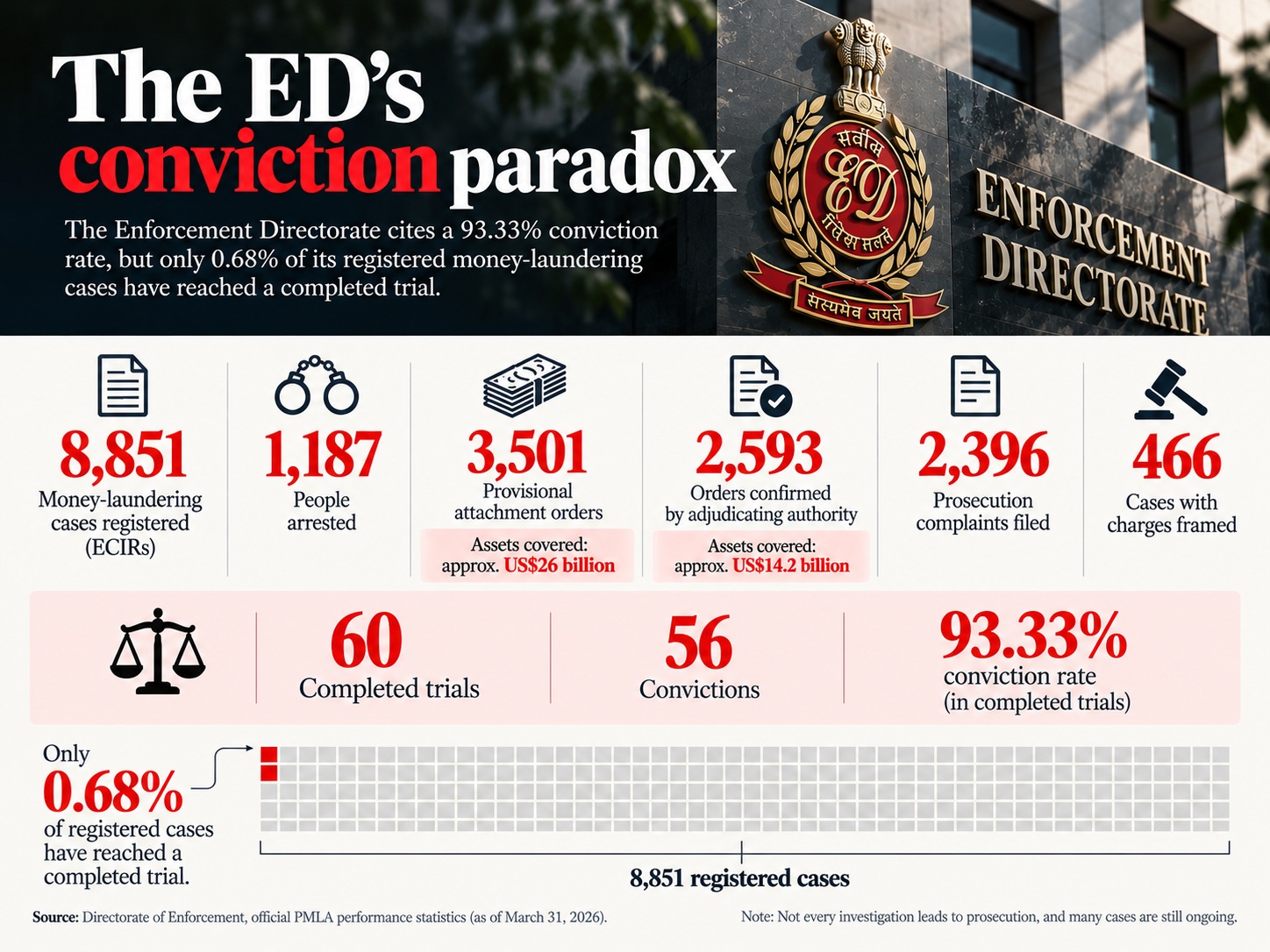
By March 31, 2026, the agency had registered 8,851 cases under the Prevention
of Money Laundering Act (PMLA), arrested 1,187 people and completed just 60
trials. It secured convictions in 56 of them, giving it a success rate of 93.33
per cent, a figure frequently cited in defence of its performance.
Those 60 trials, however, represent barely 0.68 per cent of all Enforcement
Case Information Reports (ECIRs) registered by the ED. The agency has filed
2,396 prosecution complaints, while charges have been framed in only 466 cases.
The disparity has become particularly contentious amid allegations that the ED
is being used to pursue political opponents of India's ruling Bharatiya Janata
Party (BJP). Investigations have documented a pronounced concentration of cases
involving opposition politicians, along with instances in which proceedings
stalled or were closed after political figures switched allegiance to the
ruling party.
Not every investigation leads to prosecution, and money-laundering cases can
take years to resolve, particularly when they depend on criminal proceedings
conducted by other agencies. Yet the ED can arrest suspects and attach assets
long before guilt has been established, making the slow pace of judicial
outcomes especially consequential.
Its records show that 3,501 provisional attachment orders have been issued,
covering assets worth approximately US$26 billion. Of these, 2,593 orders,
involving about US$14.2 billion, have been confirmed by the adjudicating
authority under the PMLA. Such confirmation allows an attachment to continue
but does not amount to a criminal conviction.
For those affected, the financial consequences can be considerable. Depending
on the assets involved, individuals and businesses may lose access to bank
accounts, investments or property while proceedings continue. Even when cases
eventually end in their favour, the financial losses and reputational damage
may be difficult to reverse.
The political divide
The ED's extensive powers have attracted allegations of selective enforcement,
particularly against politicians opposed to the BJP.An investigation drawing on court records, agency statements and reports of politicians who had been questioned, searched, arrested or booked, found that 115 of the 121 prominent political figures who came under ED scrutiny between 2014 and September 2022 belonged to opposition parties. They accounted for approximately 95 per cent of the total.
Between 2004 and 2014, when the Congress-led United Progressive Alliance governed India, the agency investigated 26 political leaders, including 14 from opposition parties, or 54 per cent. The number of prominent politicians investigated increased more than fourfold after 2014, with a much greater concentration among opposition figures.
The Congress, Trinamool Congress and Nationalist Congress Party were among those whose leaders faced scrutiny. The ED has maintained that its investigations are based on evidence, often arising from criminal cases registered by police or other agencies, and that political affiliation plays no role in its decisions.
Switching sides
In April 2024, The Indian Express examined 25 prominent opposition politicians
who had joined the BJP since 2014 while facing investigations by central
agencies. It found that 23 had subsequently received some form of relief: three
cases had been closed, while proceedings against another 20 had stalled or made
little progress.The investigation covered cases pursued by the ED, the Central Bureau of Investigation (CBI) and the Income Tax Department, rather than the ED alone. Its findings nevertheless raised questions about the consistency with which central agencies pursued cases involving politicians whose allegiances had changed.
Among those examined was Ajit Pawar, whose name had figured in investigations into alleged irregularities at the Maharashtra State Cooperative Bank. The Mumbai Police's Economic Offences Wing had sought to reopen the underlying case following a change in the state government, but later moved to close it again after Pawar's faction joined the BJP-led alliance in 2023. These developments also affected the related ED proceedings.
The investigation cited Assam Chief Minister Himanta Biswa Sarma, who joined the BJP in 2015 after facing CBI scrutiny in the Saradha chit fund case. It also examined former Maharashtra Chief Minister Ashok Chavan, who joined the BJP in February 2024 while proceedings relating to the Adarsh housing controversy remained stayed by the Supreme Court.
None of these developments establishes that investigators acted on political instructions. Some proceedings were affected by court orders, closure reports or other legal developments. A senior government official rejected suggestions of political interference following *The Indian Express* investigation, maintaining that investigative decisions were governed by evidence and legal requirements.
What remains unclear is whether comparable cases involving politicians who stayed in opposition were pursued with the same consistency.
When cases collapse
The ED's dependence on investigations conducted by other agencies has important
legal consequences. Under the PMLA, a money-laundering prosecution must be
linked to proceeds of crime arising from a scheduled offence, such as
corruption, fraud or other specified crimes.In its 2022 judgment in Vijay Madanlal Choudhary v. Union of India, the Supreme Court held that a money-laundering prosecution cannot survive where the accused has been finally discharged or acquitted of the underlying offence, or where the scheduled offence has been quashed in its entirety.
By the time that happens, however, the ED may already have attached assets, made arrests or filed prosecution complaints. If the underlying criminal case collapses, the legal basis for the related money-laundering proceedings may also disappear.
The 2G spectrum investigation remains one of the most prominent examples of a major corruption prosecution ending in acquittal. In December 2017, a special court acquitted former telecommunications minister A. Raja, DMK leader Kanimozhi and other accused in both the CBI and ED cases. The proceedings had dominated Indian politics for years and contributed to the corruption controversies that engulfed the Congress-led government.
The acquittals came after years of investigations and damaging publicity. They did not establish that the original investigations were politically motivated, but demonstrated how allegations of serious financial wrongdoing could shape public perceptions long before a court delivered its verdict.
Beyond politics
The consequences of an ED investigation are not confined to politicians.
Businessmen and companies can face asset restraints, damaged reputations and
prolonged uncertainty while allegations remain untested in court.The Mahadev Online Book investigation offers an example. In March 2024, the ED announced searches across several Indian cities in connection with an alleged illegal betting network with links to Dubai. The agency reported freezing securities valued at approximately US$63.9 million, besides seizing cash and other valuables.
Among those named was Dubai-based businessman Hari Shankar Tibrewala. The ED accused him of involvement in hawala transactions and links to the network's promoters, alleging that he was associated with the Skyexchange betting platform and had used Dubai-linked entities and investment structures to channel suspected betting proceeds into Indian securities.
Tibrewala has denied wrongdoing and has not been convicted in the matter. Yet his name became associated in sections of the media with hawala trading and alleged stock-market manipulation, descriptions he subsequently challenged before civil courts in Delhi.
According to reports of those proceedings, interim restraints were granted in November 2025 and June 2026 and subsequently confirmed in August 2026. The orders restricted certain media descriptions that risked presenting disputed allegations as established criminal conduct.
The courts did not determine the merits of the ED's allegations or invalidate its investigation. The orders instead addressed how a person facing criminal allegations could be portrayed publicly before guilt had been established.
Such distinctions can have consequences beyond the courtroom. Allegations made public by investigative agencies may be repeated in news reports and commercial risk databases, potentially affecting a person's reputation, business relationships and access to financial services even while the criminal proceedings remain unresolved.
Judicial scrutiny
The Supreme Court has repeatedly examined the ED's investigative practices,
including prolonged detention, stringent bail conditions under the PMLA and
delays in bringing cases to trial.In several proceedings, judges have questioned the quality of investigations and the pace of prosecutions, while emphasising that lengthy incarceration without a timely trial raises constitutional concerns.
The court has also upheld significant parts of the ED's legal framework. In its 2022 Vijay Madanlal Choudhary judgment, it upheld several key PMLA provisions, recognising the powers available to investigate complex financial crimes. Subsequent judicial interventions have addressed how those powers are exercised, particularly when investigations and trials remain pending for extended periods.
Money-laundering cases can involve offshore accounts, complex ownership structures and transactions spanning several jurisdictions. Gathering evidence and tracing funds takes time, especially when proceedings depend on criminal cases pursued by other agencies. These difficulties help explain delays, although they do not fully account for the small proportion of completed trials relative to the ED's cumulative caseload.
Accountability gap
The ED's official statistics show that 124 accused persons have been convicted
in the 56 trials that ended in conviction. The agency has also secured
confirmation of thousands of attachment orders and facilitated the restitution
of substantial assets in major financial-fraud cases.Its published figures, however, do not establish how many investigations have been pending for more than five years, how much provisionally attached property has eventually been released, or how many prosecutions have been discontinued following the collapse of the underlying criminal case. Nor do they provide a comprehensive breakdown of outcomes involving politicians from different parties.
Such information would help determine whether the concentration of opposition politicians identified in independent investigations reflects differences in the evidence available, the types of allegations pursued or inconsistencies in enforcement.
The ED's 93.33 per cent conviction rate applies only to completed trials, not its entire investigative caseload. Many cases remain under investigation or prosecution, while others may never reach trial. That distinction is particularly important for an agency empowered to arrest suspects and restrain assets before a criminal court has established guilt.
With fewer than one per cent of registered cases having reached a completed trial by March 2026, the ED's performance cannot be assessed through its conviction percentage alone. A fuller accounting would need to establish how long investigations remain open, what happens to attached assets when cases fail, and whether comparable allegations are pursued consistently, regardless of the political affiliations of those involved.